The English term "blackout" is not strictly accurate, but it is used due to its ease of recognition. Blackouts, even widespread ones, can occur for many reasons, but when we speak of a systemic failure, we mean the loss of synchronous cooperation between sources connected to a common network. The network in question may even be fully operational, but the sources disconnect from it due to failure to maintain the required technical parameters. Other useful terms include "system breakdown" or "loss of connections between sources" due to the lack of conditions for stable cooperation, and (again, except for a possible initial event), in a network that is usually intact.
The report of the Government of the Kingdom of Spain dated June 16, 2025, begins with a dozen or so pages of various caveats and explanations, and we will begin with the same. As an introduction, we will present a quote from page 149 of T.A. Heppenheimer's book "Countdown: A History of Space Flight."
Korolev began preparations for the first launch in February 1957, hoping to fly the following month. However, delays occurred, and the launch was postponed until May. On May 15, the first R-7 took off. However, a fuel line ruptured, causing a fire and the rocket to explode after only 100 seconds of flight. It turned out that the work in Korolev's hangar had been botched by careless installation of the line.
On June 9th, two days before the Atlas's first flight, Korolev tried again. This time, the engine wouldn't start. Once again, it turned out to be his assembly shop's fault, as someone had installed the fuel valve in the wrong position. These two examples of poor workmanship are too many to be a mere coincidence. As Korolev's biographer, Yaroslav Golovanov, writes, "Korolev never began his search for the cause of a failure by analyzing his own mistakes." He preferred to act as if his rocket design was perfect, while eagerly shifting the blame entirely to Glushko. As a result of these arguments, errors sometimes remained unresolved.
Korolev tried to evade responsibility this time as well. He had to write a report: so he prepared it in a sophisticated manner, laboriously listing a long list of possible sources of failure, citing the "most probable cause" at the very end. However, his superiors were too experienced to be led by the nose. "What a clever fellow you are..." one of them said. "So much stench about what others might have ruined, and so much perfume in your own shit..."
The cited book is from 1997, originally titled "Countdown: A History of the Space Program." We highly recommend Mr. T.A. Heppenheimer's work, as he masterfully describes the processes occurring at the intersection of politics, technology, and technological management. To be clear, the recommended author is not a Russophobe and describes the intricacies of American politics with equal insight. It would be very superficial to view this book as, for example, a chronology of rocket launches, although the technology itself is well-described. Equally important is the description of ways to motivate millions of people to undertake fascinating, moving, and... utterly useless space flights.
We can determine certain things, or even speculate, right away, even before we begin reading the report on the blackout in Spain on April 28, 2025. There's no doubt that the primary goal of the Government of Spain's report in question is to "keep it from getting wet." "Keep it from happening," to not write anything that could harm the Government of Spain. This is an inherent characteristic of every serious document. For example, the primary goal of any legal opinion written by a reputable and well-paid lawyer is not the client's best interest, even if that lawyer is employed by the company they represent—the primary goal is to avoid harming themselves and to shift the risk to the person receiving the opinion. Most of us have also attended occupational health and safety training—the "health and safety officer" will surely explain to you that he is never responsible for anything, as the responsibility lies with the employer or employee, and our "health and safety officer" is merely "helping."
Only possibly the second purpose of the report in question is to explain the causes of the failure, partly on a hobby basis and partly to secure the interests of the Government of the Kingdom of Spain in the future.
All stakeholders also know in advance that this report must not generate criticism of renewable energy sources, and photovoltaics in particular. This is a game with the highest stakes, and any failure would necessarily lead to the downfall of all the socialist European governments involved for almost a quarter of a century in a flawed, ineffective, and costly renewable energy project. We have not used the term "controversial project" here, because this project does not merit the use of social engineering tricks to weaken its rhetoric.
An example of this stench-inducing mischief is the section on the cyberattack in the report under discussion. The cyberattack wasn't the cause of the outage, but the report could always be pasted with dozens of pages of standard descriptions about access authentication requirements, password strengthening, etc. Overzealous services will always have a chance to prove themselves after a disaster (this mechanism is brilliantly described in the first pages of “Švejk” by J. Hašek), and we all love it when overly bloated security procedures start to paralyze a company...
We also owe the reader a general overview. Despite, as we remember, the temporary share of renewable energy sources (RES) was 100%, the annual shares are somewhat different, and the "record" itself was also fabricated.
We provide average data for 2024 for Spain.
Demand 26.1 GW (18.6 GW in Poland)
Generation 29.7 GW
Wind and solar share of demand 46.3 % (43.4% in Germany)
Wind and solar share of generation 40.7%
Data for the record quarter of April 16, 2025, 11:15 AM, according to Entso-e
Demand 27.8 GW
Generation 35.1 GW
Wind and solar share of demand 90.2%
Wind and solar share of generation 71.6 %
Data just before the outage, April 28, 2025, according to Entso-e
Demand 24.9 GW
Generation 31.9 GW
Wind and solar share of demand 88.3 %
Wind and solar share of generation 68.9%
Despite Spain's much-publicized 100% renewable energy generation, wind and photovoltaics
are highly inefficient sources, achieving a mere 46% share of demand annually. This seems to be
the limit of this technology's potential without a miraculous solution for large-scale storage,
because beyond a temporary share of around 58% renewable energy, all countries using this
technology are forced to unprofitably export the surplus. Physics and technology, even in Spain,
restrain ideological lunatics, and even during the record quarters mentioned above, the share of
stable sources in generation was maintained at around 30%.
In this case, during the record quarter of April 16, 2025, at 11:15 AM, the share of coal, gas, and
oil was 11% (otherwise nuclear, biomass, and controllable hydropower). A smaller part of the
excess renewable energy is taken over by pumped-storage power plants, but generally, countries
with a large share of PV, such as Spain, Germany, and unfortunately also Poland, only survive
(electrically) thanks to the support of their neighbors.
Let's reiterate that even during peak PV peaks, no one in their right mind would turn off
controllable sources (even at noon, it's clear that in a few dozen minutes, photovoltaic
production will only be dwindling), and saving the balance is only possible through exports. At
such times, only French nuclear power plants in Europe are currently regulating. Let's never
forget that renewable energy sources are dependent on self-sufficiency, and considering their
cost without considering the cost of support, for example, is self-deception.
The report was adopted by the Spanish authorities on June 16, 2025, and leaked into the unofficial media under the English title "Non-confidential version of the report of the committee for the analysis of the circumstances surrounding the electricity crisis of April 28, 2025." As the name suggests, it is "not secret," meaning it is mercilessly censored and filled with black lines. Our generation, raised under communist rule, is perfectly capable of reading between the lines of official communications. If someone is censoring something, that's precisely what they fear most.
We understand that there's no need to disclose, for example, the names of power plants that merely shared research data; let this be a form of image protection. We also understand that we shouldn't allow lynching of entities that may be guilty in some way. But, for example, classifying the type of energy source, such as the term "photovoltaics," has no legal justification. Recall the complaints about the system of classifying all critical information in the USSR, which liberals contemptuously called communist paranoia. This undoubtedly contributed to the failure to disseminate information about the RBMK reactor's weaknesses among Soviet engineers, and for this reason, even though certain threats had been identified earlier, the engineers at Chernobyl lacked sufficiently well-grounded knowledge of them.
Immediately after the failure, public opinion lynched photovoltaics. Note, however, that this lynching wasn't carried out by haters and conspiracy theorists, but by renowned specialists and professors of electrical engineering. They accused photovoltaic systems of having low inertia, meaning they lack the ability to suppress interference. Therefore, it's also clear that one of the goals of the Spanish report will be to show the experts a Kozakiewicz-esque gesture, with the implicit "see, you were wrong; the system's low inertia had no effect."
But before we begin reading the Report, let's consider the probability that the source of the disruption could have been 11% of coal-fired power plants, proven over a century, and the probability that renewable energy sources could have covered 88% of demand. The demand itself was low by Spanish standards, and the share of photovoltaics alone in the demand was 77%.
Both the Kingdom of Spain's report and the somewhat more substantive, unfinished Entsoe report indicate that the system was not operated stably on the day under review. Power/frequency instabilities and swings occurred at least twice. The first swings occurred between the two halves of Spain. More precisely (if such stroboscopic photography were possible), we would have seen that all installations in the southeastern part of the country rotated with a different phase angle than sources in the northwestern part. The problem was solved by increasing the number of connections between the parts of the country in question, but at this point we owe the reader a specific technical explanation regarding the technique of maintaining voltage in the grid.
The voltage in a closed network is an indicator of reactive power balance. If there is too much reactive power of the wrong sign in the network, the voltage increases. The term "of the wrong sign" is used because electrical engineering theory knows that there is interchangeability in terminology, and "generation of inductive reactive power" also means "consumption of capacitive reactive power." Reactive power can be supplied to the network by: generating sources, various types of separate compensators, and, note: "empty" power lines, i.e. lines not loaded with active power flow.
Below is a figure from the more readable Entsoe report (copied July 18, 2025). It shows the
voltage waveform at the Carmona substation and the net active power exchange status in Spain
in the minute preceding the blackout (source: PMU data from Red Eléctrica).
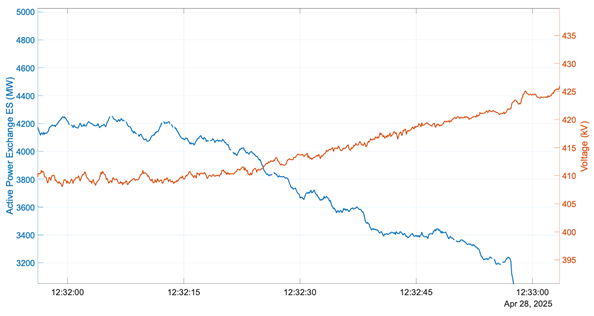
The blue graph shows that active power in the exchange lines decreased while the voltage
(orange graph) increased. The appendix at the end provides additional details on reactive power
regulation in the power system.
Therefore, let's note that when more "empty" lines were connected to the system under relatively low load conditions, the stability problem requiring strengthening the bonds between the two halves of Spain was indeed solved, but it also added voltage to the grid, and ultimately, this voltage increase was the cause of the outage cascade. In current practice, this wouldn't have been a problem, as reactive power was regulated by coal-fired power plants, or in Spain, gas-fired power plants, but remember, these were few in number. Spanish operators complained that this residual stability poorly regulated reactive power, that someone had allowed a gas power plant to idle. Whether this penultimate gas power plant was put on hold for repairs or simply refused to operate with negative electricity prices will be determined by climate historians. In any case, the reader will want to note that the author is misleading them just as much as the Spanish Greens, directing the narrative towards the "blame" of fossil fuel power plants, of which... 11%.
How could you, climate apologists, imagine that with 100% renewable energy, you'd still be blaming coal for system control and maintenance? That supposedly, defunct coal-fired power plants would be responsible for voltage and frequency regulation? It's probably obvious that with such a share of renewable energy, it's time to finally take responsibility, but be warned – that would be the end of the days of joyful creativity, and it wouldn't come for free. At least the Spanish admit to this, and the "Report" in question states on page 66:
In turn, renewable energy sources, cogeneration and waste, in accordance with Royal Decree 413/2014 of 6 June, are subject to the capacity factor (i.e. in the old way), although for years renewable energy sources have already had the technological capabilities to operate in generation mode, the regulations do not yet require or allow them to do so.
In other words, the policy of "maximum profits and zero system obligations for renewable energy sources" was at fault. Even in the area of voltage regulation, where there are some technical possibilities, European governments have been asleep since 2014 (as in Spain), limiting their activities to massive subsidies for photovoltaics and "crackdown" on power plants responsible for the system.
Of course, the Spanish admit that it's more or less common knowledge that some attempt can be made to fix it. This method (using renewable energy sources to regulate voltage) will be available for use during renewable energy production. During renewable energy outages, controllable power plants are theoretically supposed to return, but be warned: the Greens, due to the disproportion between peak renewable energy sources and demand, are demanding the construction of too many connections – those without load will always become unnecessary, and there will always be the (costly) problem of regulating their voltage, so in the case of photovoltaics, they would have to be shut down daily.
After the power swings within Spain were resolved, power swings between Spain and the rest of Europe occurred, which were resolved again by strengthening the links between them on international connections. Furthermore, the "European" 0.2 Hz oscillations were superimposed by 0.6 Hz oscillations originating specifically from a source in southern Spain with a censored name..
Ultimately, subsequent oscillations led to a decrease in power flow on the transmission lines, so we once again had a case of low-load lines being switched on, thus favoring voltage increases. And during the emergency shutdown of the sources, the voltage continued to increase instead of seemingly decreasing, until the system collapsed, when the voltage finally dropped, but to zero.
Power system stability textbooks describe many types of stability, including local, global, frequency, voltage, angular, instantaneous, and long-term stability. For reasons of academic accuracy, scientists described all types of threats, including low and high voltage, but the focus was always on the threats resulting from parameter deficiencies. Undoubtedly, voltage sags are dangerous because they ultimately lead to power outages, including those at the power plant itself, where, despite normal operation, the drives simply stop working. All of us, raised under communist rule, have it ingrained in our minds that power or voltage deficiencies are dangerous. This also aligns with the life experience of anyone in any industry. Undoubtedly, shortages of anything can be dangerous, especially drug shortages.
Renewable energy advocates try to defend themselves by claiming that failures have also occurred in existing systems. Yes, most often, as stated, due to a shortage of some factor or a "specific failure," such as a line failure. Meanwhile, we're probably seeing the first case of a failure caused by excessive voltage in the system. Let the reader decide what changes have occurred in the way electricity is generated in the system in recent years?
So what about inertia? Were the certified electrical engineering professors wrong? Not so fast. First, let's recall what inertia is. Previous generators were rotating machines with rotors weighing tens and hundreds of tons, so they had a moment of inertia. We can measure it, for example, in [kg*m²], but generator inertia is also measured in seconds. And now, in the event of disturbances, such as short circuits, for a duration of 50-150 ms, there is a significant change in active power consumption. But generators with an inertia of around 5 seconds "fly" through this period under the force of inertia. The mass of the rotating machine itself protects it from changing its frequency into an unacceptable range. If the machine wants to accelerate, its inertia releases its own braking energy and similarly protects itself from attempts to slow down. As you can easily see, the greater the inertia, the better. Meanwhile, photovoltaics have no inertia at all; their inertia is zero seconds. A system equipped only with photovoltaics does not have the ability to suppress interference, should it occur for any reason.
The figure below shows the speed of an example generator in Poland after a disruption during a
storm passing over the city. We also show how long the electrical disruption lasts – it's
impossible to accurately depict the current waveform on this scale, but the black dot on the
graph, measured in amperes, represents 100 ms, 5 full sine cycles.
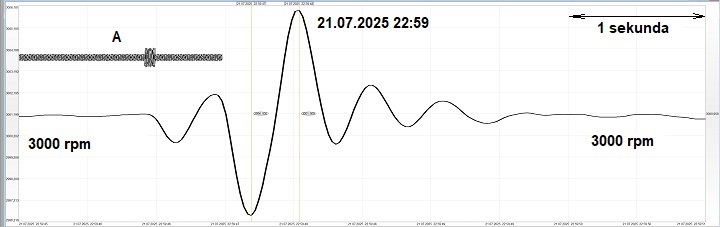
As you can see, in a stable system, three seconds after the disturbance, "there was no problem",
and the average person will only notice a blink of light caused by a voltage dip for 100 ms.
Below we paste a drawing from the Spanish report with a "slightly" different description.
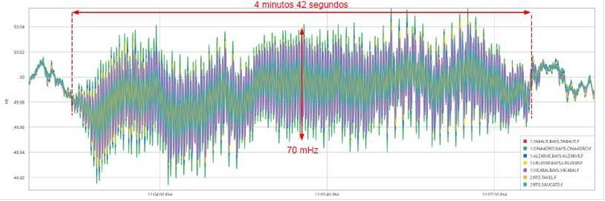
Oscillation at 12:03. The first significant oscillation occurs at 12:03, has a frequency of 0.6 Hz
and an amplitude of 70 mHz. It takes 4 minutes and 42 seconds to decay.
Typically, system inertia is tested to ensure it will withstand disturbances such as short circuits. In this case, there was no short circuit at the beginning of the outage, and the frequency dropped slowly during the source shutdown, so the issue was dismissed and it was announced that the low inertia had no bearing on the outage.
Moreover, according to the Spanish government, the system's inertia was greater than Entsoe's recommended value of 2 seconds, so that's it. Hooray, hooray – where the report should have been detailed, it wasn't. It didn't specify whether these 2 seconds were an average, global value, nor did it specify whether local stability conditions were maintained, for example, in the region where the disturbances were more severe. Furthermore, traditional machines offered inertia of 5 to 9 seconds, and 2 seconds is several times less than maintained in safe systems.
Let's recall what so stressed the Spanish operators at the beginning of the whole affair – after all, it was frequency fluctuations, the system was unstable. And when would it be more stable – certainly when it had greater inertia. I think anyone without academic arguments will understand this – any system with greater inertia is less susceptible to interference – a larger mass is harder to push. This may be a hindrance to rapid regulation systems, but we'll counter immediately – with greater resistance to interference, rapid regulation may not be necessary. In this single paragraph, we have the author's own investigations – they seem to have some basis.
And finally, even if the issue of low-inertia photovoltaics wasn't at the forefront of attention right now, that doesn't mean it's nonexistent. We recommend "Project Inertia – ENTSO-E," which is described in considerable detail on the European organization's servers and is not trivial – unionists are proposing the purchase of supercapacitors across Europe with a total capacity of 445 GW and a capacity of just a few seconds, which will, of course, be costly. (We're talking about simulating the rotating mass of the generators of all existing power plants using power electronics, and this entire cost would be solely for improving stability.)
And finally, once again, Entsoe's investigation hasn't been completed. The Spanish report had to be published quickly. In the case of a technical organization, even if political pressure is present, it's inappropriate to produce reports on the spur of the moment. Especially when several years of research have been devoted to officially demonstrating the lack of inertia in renewable energy systems. Inertia, that is, the ability to spontaneously dampen or suppress disturbances.
Let's add that the Spanish report proposes the use of additional measures to improve stability known in electrical engineering, such as tweaking so-called system stabilizers in generator excitation control systems or selecting an appropriate network topology. However, it's important to emphasize that these are additional measures. First, we want the system to be inherently stable.
Other important observations that the Spaniards (surprisingly) quite boldly conveyed include drawing attention to, we quote: the decline in solar generation power in the absence of any meteorological phenomena that could explain it, the most probable explanation being that it is caused by market factors (prices).
(The aforementioned generation drop was correlated with voltage increases in the relieved
exchange lines.) The Spanish complained because such situations occur due to neoliberal
trade. Negative prices were supposed to begin on the exchange during the hours under review,
so a sudden change in generation occurred. The underlying complaint about disruptions caused
by green business is blurred in the report and appears every few dozen pages, but we will quote
from page 115 of the report.:
The start of trading on the daily quarter-hour market was planned for June 11, 2025, but this
date was recently postponed to October 1, 2025. With the daily quarter-hour market, the
scale of the 15-minute program fluctuations will potentially be greater, as the daily market
mobilizes the most energy.
The complaint about power surges resulting from neoliberal trading is repeated in both the descriptions of the events of 10:30-11:15 and 12:27, we guote: "According to the System Operator, this linear increase in voltage is due to the following factors: at 12:27, a schedule adjustment begins at the Spain-Portugal transmission hub, which was agreed at 12:20 for 12:30 between REE and REN."
Ladies and gentlemen: electricity systems developed without any energy exchanges 100 years ago in countries with fully developed market economies, simply in fully capitalist countries. Energy exchanges are an invention of the last two decades, based on an alliance between green socialists and capitalists based on the principle of "you have your climate protection, we have the business." Operators in grid control centers are no longer electricians; they are executors of stockbrokers' orders. The Greens explain that this allows energy to flow from places where there is too much of it to places of demand, but this contradicts their much-publicized goal: "thanks to renewable energy sources in distributed generation, costly transmission will be reduced." In existing systems, power plants were built at the center of the load. And it's precisely renewable energy that forces us to transmit large amounts of energy, especially the transmission of energy from wind turbines in the Baltic Sea to southern Poland, Germany, and Europe in general. Besides, let's be honest – during midday hours, ignoring a slight shift due to longitude, there's too much photovoltaics everywhere. Even with perfect grid access, there's nowhere to transmit this excess electricity at midday. And if, a moment later, there's not enough electricity, that's a grievance against the (Creator of) photovoltaics. Incidentally, Spanish operators complained about the organizational mess resulting from the joyful development of renewable energy – the companies and subsidiaries responsible for operating these sources literally took on the form of a "Christmas tree" attached to grid nodes, so investigators simply had trouble finding anyone to contact for information.
Renewable energy developed easily by leaving all system responsibilities to stable power plants. They offered, within a single service, free energy supply in quantities on demand (controllability), 30-day energy storage (coal piles, gas caverns, etc.), inertial storage for a few seconds, and grid voltage regulation. Renewable energy only offers uncontrollable energy, and all other functions would have to be replicated using separate systems. Each of these would be so expensive that, according to current knowledge, it would be impossible to implement. EU politicians are attempting to create a system based on renewable energy, defying the fundamentals of physics and economics, and their main goal – a world of free energy – remains as distant as it was at the beginning of their project. Readers will want to decide for themselves whether the author is wrong or credible by looking into their wallet or their company's budget.
Annex.

The figure on the left shows the reactive power of the line depending on the rated voltage and
load level. The figure on the right shows a pie chart of a 200 MW generator. The line power graph
was taken from "Power System Stability" by Jan Machowski and Zbigniew Lubośny.
As you can see, an underloaded 400 kV line requires 40 Mvar of capacitive reactive power per 100 km, while, for example, a generator with an active power of 200 MW can only deliver 80 Mvar when operating in an unloaded state. Therefore, a single such generator can compensate for only 200 km of line. Therefore, once again, the demand for the construction of more lines and the faster decommissioning of commercial power plants is an obvious contradiction.
This also poses a significant challenge when attempting to start the system "from scratch." For example, a small hydroelectric power plant will not be able to supply voltage to start a commercial power plant unless the problem of reactive power compensation in the line connecting the plants in question is resolved.
3.08.2025 Grzegorz Kwiecień
Postscript 06.08.2025. It's also worth noting how photovoltaics are currently performing at the local level. Let's imagine we want to renovate a low-voltage line. So we shut down our Kozia Wólka Dolna power line (it's important not to oend the guys from Kozia Wólka Górna), and the photovoltaic system correctly detects the lack of voltage and shuts down. Then we connect a portable diesel generator with its own voltage regulator, of course, adapted for standalone operation, and the photovoltaic system on all the barns in the village detects the return of voltage. Consequently, it automatically returns to saving the climate, except it doesn't know that it can't currently export excess power to this grid, and so begins the Spanish game on a Polish district scale... (Authentically overheard during dispatch training, and that was before we even got to the part about consumption.)